


NEURO-RESPOND

Project Snapshot

Status

On-going

Start Date

2026

End Date

2026

Programme

Partners

OHB Hellas role

Prime

The Objective

NEURO-RESPOND is an ESA SysNova activity led by OHB Hellas, focusing on the use of neuromorphic computing and event-based sensing for future Earth Observation missions.
The project investigates how low-power, event-driven on-board processing can reduce latency, downlink volume and ground dependency in time-critical applications. Instead of sending large volumes of raw data to ground for later analysis, NEURO-RESPOND studies how the spacecraft can detect relevant activity, filter information, and generate compact alerts directly on-board.
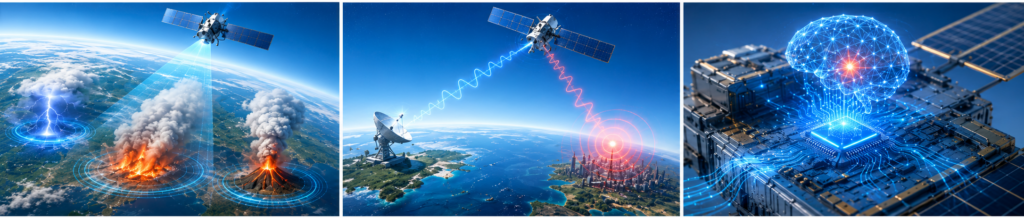
The mission concept is built around three complementary applications. Transient Sentinel targets near-real-time detection of fast Earth Observation events such as lightning, wildfire signatures and volcanic activity. RF Watch investigates on-board detection of RF interference and support to mitigation decisions. Neuromorphic FDIR explores low-power monitoring of spacecraft telemetry for early anomaly detection.
Together, these use cases allow the study to assess whether a shared neuromorphic processing concept can improve mission-level KPIs such as alert latency, autonomy, power consumption, downlink volume and effective duty cycle. This is consistent with the NEURO-RESPOND kick-off presentation, where the core question is whether neuromorphic on-board processing can improve latency, autonomy, power and data volume across heterogeneous spacecraft applications.

OHB Hellas Contributions

OHB Hellas leads the NEURO-RESPOND activity and is responsible for the overall coordination of the consortium.
The main contributions include:
• Definition of the mission concept, target applications and mission-level KPIs
• Application-level analysis for Transient Sentinel, RF Watch and Neuromorphic FDIR
• Development and selection of representative neuromorphic demonstrators
• Assessment of execution strategies, scheduling and workload coexistence on a shared neuromorphic resource
• KPI-driven benchmarking of latency, power, data reduction and autonomy benefits
• Coordination of the study outputs and preparation of inputs for future ESA CDF activities
OHB Hellas brings previous hands-on experience in on-board AI, hardware acceleration and neuromorphic model deployment. This includes work with BrainChip Akida, embedded AI accelerators, synthetic data generation and representative space-oriented AI workloads. The activity builds on this experience to mature neuromorphic processing from isolated demonstrators towards mission-level architectural trade-offs.

Related project in Orbital High-Performance Computing