


SIRIUS

ARTES 4.0 Secure Satcom for Safety & Security (4S)

Project Snapshot

Status

On-going

Start Date

2026

End Date

2028

Programme

ARTES 4.0 Secure Satcom for Safety & Security (4S)

Partners

OHB Hellas role

Work package lead: AI interference detection and classification

The Objective

SIRIUS (Smart Interference-Resilient Intelligent Unified SatCom) responds to the ESA call “AI-Enhanced Adaptive Antenna Array for SatCom Terminals for Automatic Interference Detection and Mitigation”. It is carried out by an all-Greek consortium led by Intracom Defense, with Argo Semiconductors, OHB Hellas and the National and Kapodistrian University of Athens.

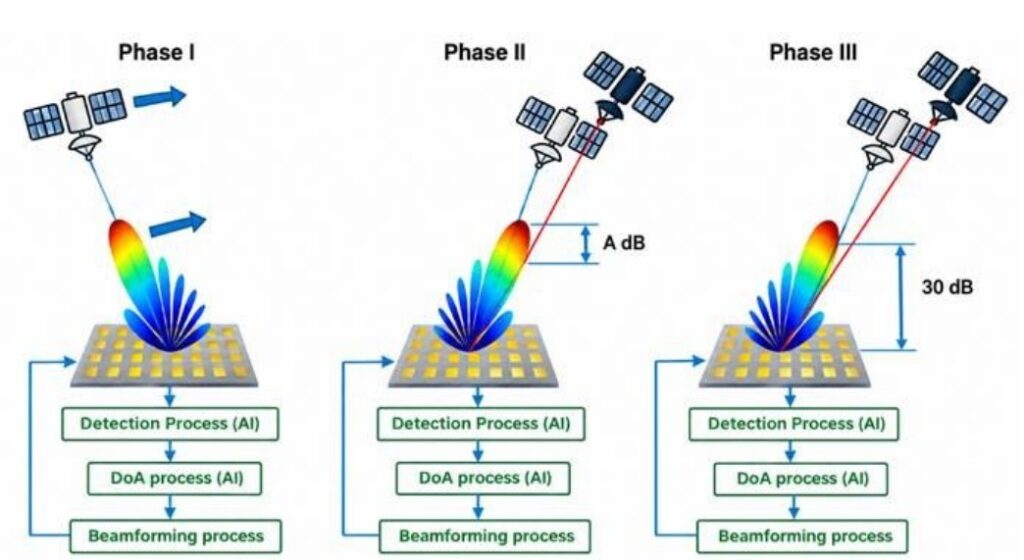
Its primary objectives are to develop an AI engine that identifies the direction of arrival of interfering signals, and an AI algorithm that dynamically reconfigures the antenna array to mitigate the interference while maintaining connectivity. An antenna array demonstrator integrating these functions will be designed, manufactured and tested.

The goal is better signal quality and higher security: reducing interference by 30 dB, in real time, with 50% less computation time than existing solutions.

SIRIUS concept in three phases: the array tracks the satellite, detects an interferer and its direction of arrival with AI, then reshapes its beam to suppress the interferer by 30 dB

OHB Hellas Contributions

OHB Hellas leads the work package that develops the Interference Detection and Classification Algorithm (IDCA), the AI that spots the interferer. It covers:
• Data gathering and data generation to train the IDCA
• Preliminary and detailed design of the algorithm
• Preliminary and final software versions of the IDCA

OHB Hellas also leads the work packages that implement the preliminary and final software on available hardware, building on its Orbital High-Performance Computing expertise. Our engineers support all the other work packages, towards the successful delivery of the project.

SIRIUS project logo

Detect it, locate it, cancel it, in real time

Satellite terminals increasingly have to keep their link up while other signals compete for the same spectrum. Constellations are growing, terrestrial and satellite networks reuse the same bands, and interferers, accidental or deliberate, move and change. Fixed filters cannot keep up. SIRIUS gives the terminal’s antenna array the intelligence to adapt.

SIRIUS at a glance

30 dB

interference reduction targeted

−50%

computation time compared with existing solutions

24 months

from September 2026 to August 2028

TRL 5

antenna-array demonstrator, starting from TRL 3–4

How it works

The system combines three components: the antenna array, an AI-driven interference detection and classification module, and an interference mitigation engine. Together they suppress unwanted sources by reshaping the antenna radiation pattern.

At the start of the project, the consortium selects the most suitable array configuration, trading hardware complexity against beamforming flexibility (analog, fully digital or hybrid). The AI model is trained by supervised learning on beamspace-derived features: per-beam power distributions, time-frequency representations and compact covariance descriptors computed over short time windows. The mitigation engine then manages the resulting radiation patterns to suppress the interference.
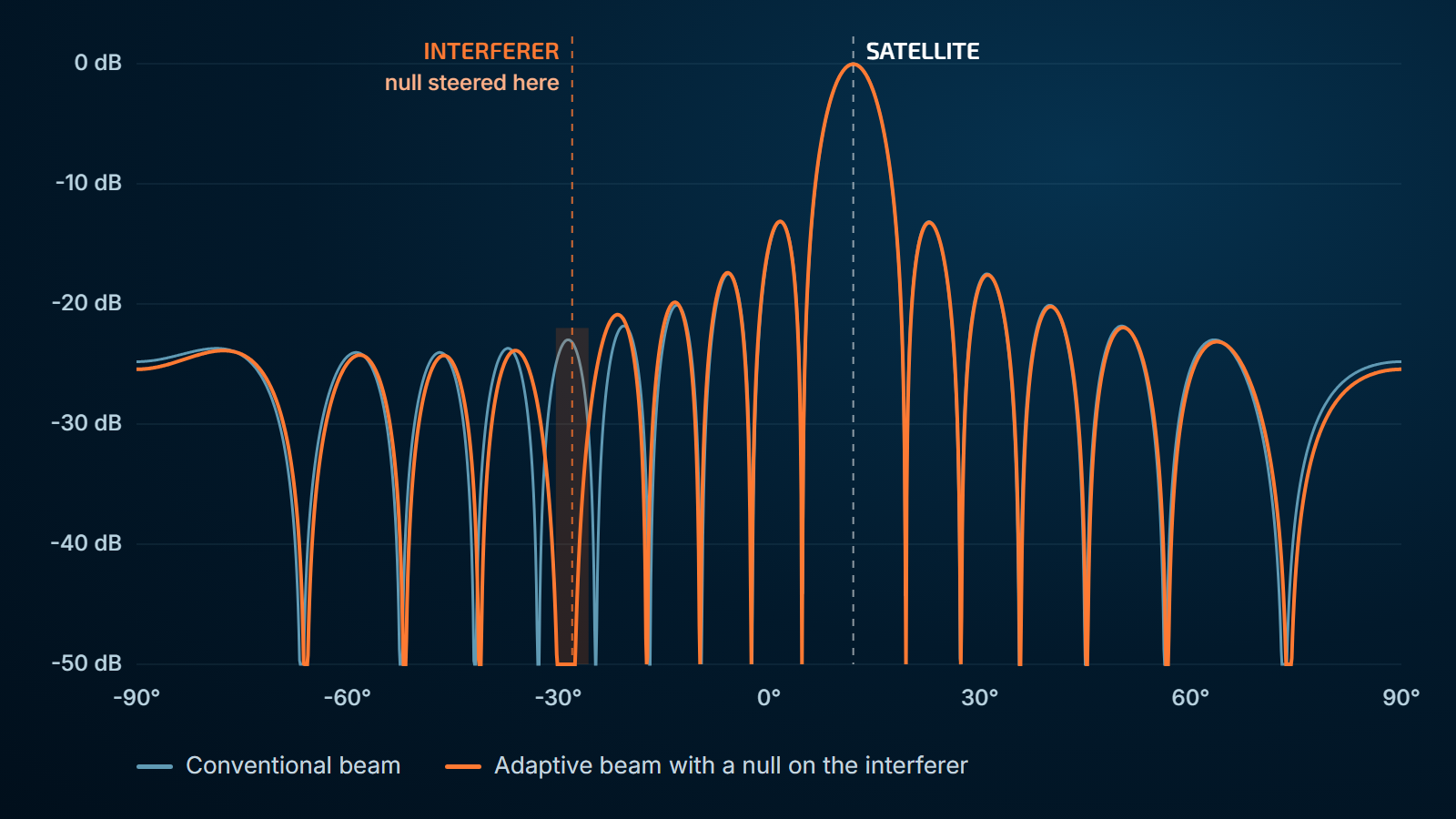
Chart of normalised antenna gain from -90 to 90 degrees: the conventional beam and the adaptive beam both peak on the satellite at 12 degrees; the adaptive beam drops below -50 dB at the interferer at -28 degrees
Illustrative array-factor computation for a 16-element array: the adaptive beam keeps full gain on the satellite and places a deep null on the interferer.

The design targets wide field-of-view beam steering with reduced grating lobes, interference suppression above 30 dB, operation under several simultaneous interferers, and fast reaction times.

Milestones

MilestonePlanned
Kick-offSeptember 2026
System Requirements ReviewKick-off + 3 months
Baseline selectionKick-off + 5 months
Test Readiness ReviewKick-off + 13 months
Detailed designKick-off + 17 months
Final ReviewKick-off + 24 months

More about the activity on the ESA project page.


SIRIUS is carried out under a programme of, and funded by, the European Space Agency (ARTES 4.0). The view expressed herein can in no way be taken to reflect the official opinion of the European Space Agency.

Related project in Orbital High-Performance Computing, Satellite and Ground System