



To AI or not to AI?
Scientific instruments produce more data than a spacecraft can send home. Hyperspectral imagers, SAR and magnetometers fill limited onboard memory, and the downlink, with its limited bandwidth and contact time, becomes the bottleneck. Compressing on board helps, but the data must keep its scientific value and the processing must fit a tight onboard budget.
The CCSDS standards are today’s baseline. AI-based compression is an emerging alternative. AIRGUS sets out to measure, fairly and reproducibly, where AI actually pays off.
AIRGUS at a glance
1D · 2D · 3D
time series, images and SAR, hyperspectral cubes
2 approaches
predictive and end-to-end neural compression
CCSDS
121, 122 and 123 as the reference
TRL 4
target, on an AMD Versal breadboard
Two ways to put AI into compression
Predictive compression uses a neural network to predict each sample and encodes only the prediction error. Every sample keeps a guaranteed error bound, the same principle as CCSDS 123.
End-to-end compression learns the whole transform, quantisation and reconstruction. It controls the average quality of the data, not the error of each sample.
Because their error-control properties differ, the fidelity a mission requires decides which approach is eligible. A policy layer in the AIRGUS framework selects neural or CCSDS compression by data type, fidelity and onboard resources, with CCSDS kept as a verified fallback.
First results at OBPDC 2026
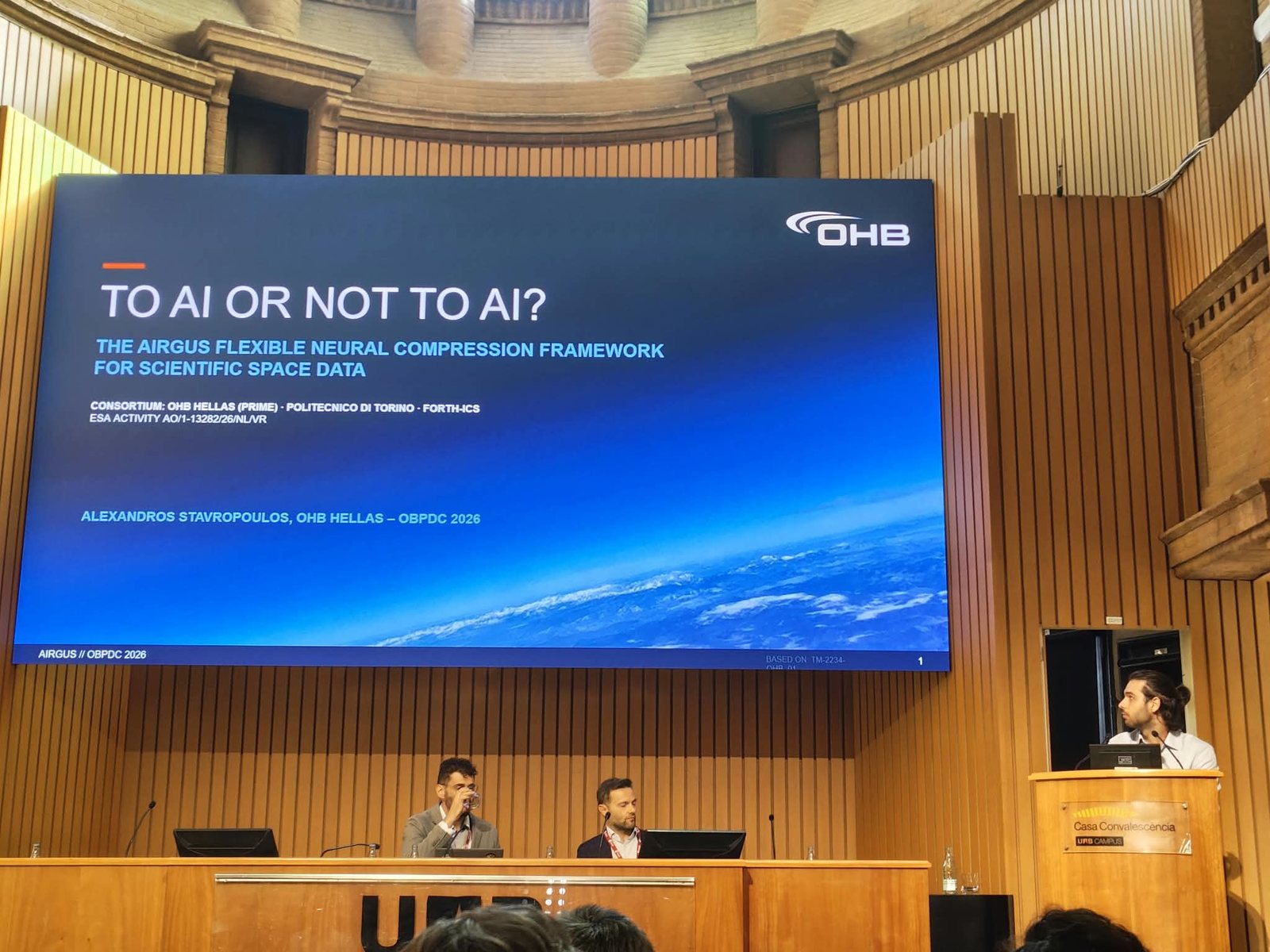
OHB Hellas presented AIRGUS at the 10th International Workshop on On-Board Payload Data Compression (OBPDC 2026), organised by ESA and CNES and hosted by the Universitat Autònoma de Barcelona, 12 to 14 October 2026. The preliminary picture is nuanced: a neural predictor has outperformed CCSDS 123 on a hyperspectral dataset, and learned codecs lead on Sentinel-2 imagery at high compression, while CCSDS keeps improving at higher bit rates. AI-based compression does not, in general, outperform the standard; the benefit depends on the data, the required fidelity and the onboard resources.
Built for the science missions of tomorrow
Future ESA science missions, including scenarios for Saturn’s icy moon Enceladus, will collect far more data than they can downlink. AIRGUS gives mission designers the evidence to decide how that data should be compressed on board.
Next steps
| Step | What happens |
|---|---|
| Consolidation | Datasets and acceptance criteria |
| Trade-off analysis | Controlled software comparison against CCSDS |
| Selection | One neural approach for the breadboard |
| Implementation and verification | AMD Versal VCK190 breadboard, target TRL 4 |
AIRGUS is carried out under a programme of, and funded by, the European Space Agency (Technology Development Element, TDE). The view expressed herein can in no way be taken to reflect the official opinion of the European Space Agency.